



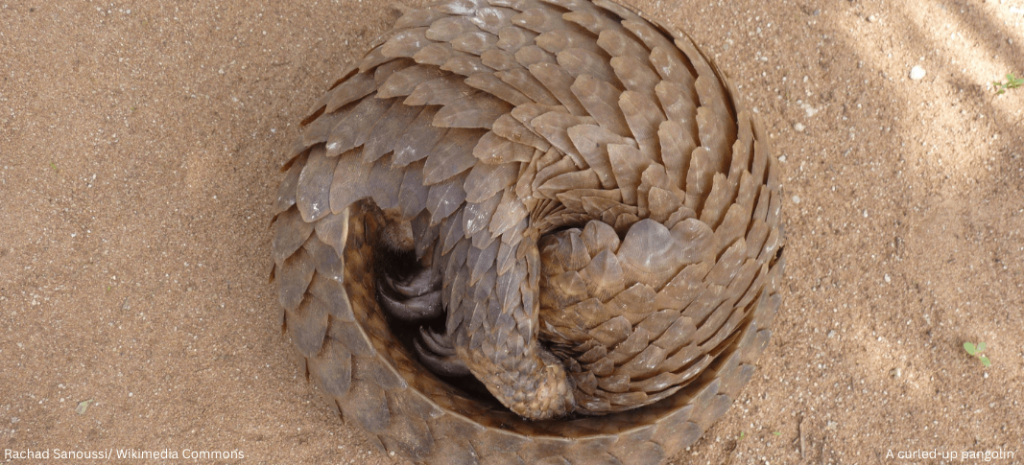
Curled into a tight ball, this scaly creature looks more like a giant pinecone than a mammal. Their body is covered in tough, overlapping scales that act as natural armour. With strong claws for digging, no teeth, and a long, sticky tongue almost as long as their body, pangolins feed on ants and termites with remarkable efficiency.
Can you guess what this creature is?
Meet the pangolin! Pangolins are shy and rarely seen mammals, and unfortunately also among the most illegally trafficked animals in the world.
This World Pangolin Day, let’s learn more about this incredible species.
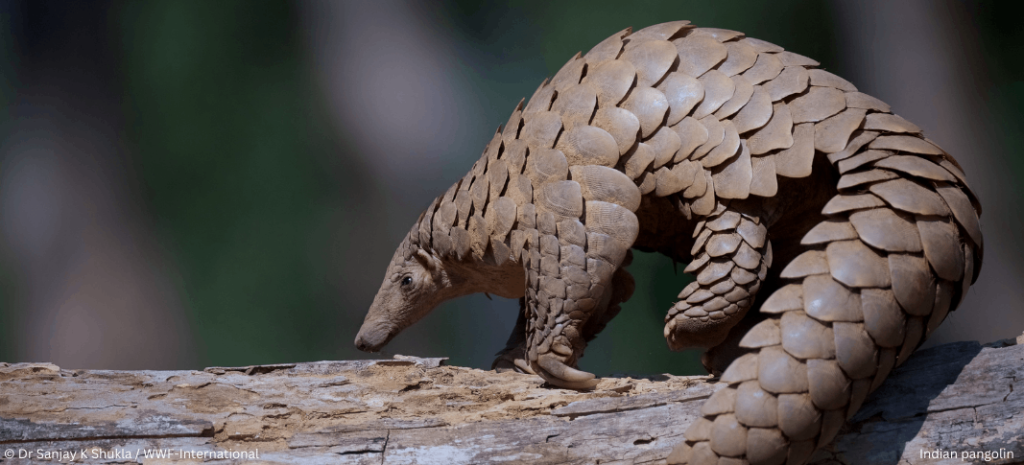
Found across parts of Asia and Africa, they live in forests, grasslands, and scrublands, and are mostly active at night. There are eight species worldwide, including two found in India: the Indian pangolin (Manis crassicaudata) and the Chinese pangolin (Manis pentadactyla).
The Indian pangolin has a wider distribution and can be found across many parts of the country, while the Chinese pangolin is restricted mainly to northeastern India and is now extremely rare. Explore this biodiversity map of Assam and try to spot the Chinese pangolin! Despite their ability to adapt to different environments, pangolins depend on healthy habitats and minimal human disturbance to survive.
Pangolins, often called scaly anteaters, feed almost entirely on ants and termites. With powerful front claws, they tear open nests and tunnels, then extend their long, sticky tongues to extract insects from deep within. Unlike ours, their tongues are not rooted in the mouth. They extend far into the body, enabling them to reach deep inside narrow passages with precision.
Because they have no teeth, pangolins swallow their prey whole. Their muscular stomachs, along with ingested grit and small stones, help grind the food for digestion. A single pangolin can consume tens of thousands of ants and termites in a day, making them natural regulators of insect populations.
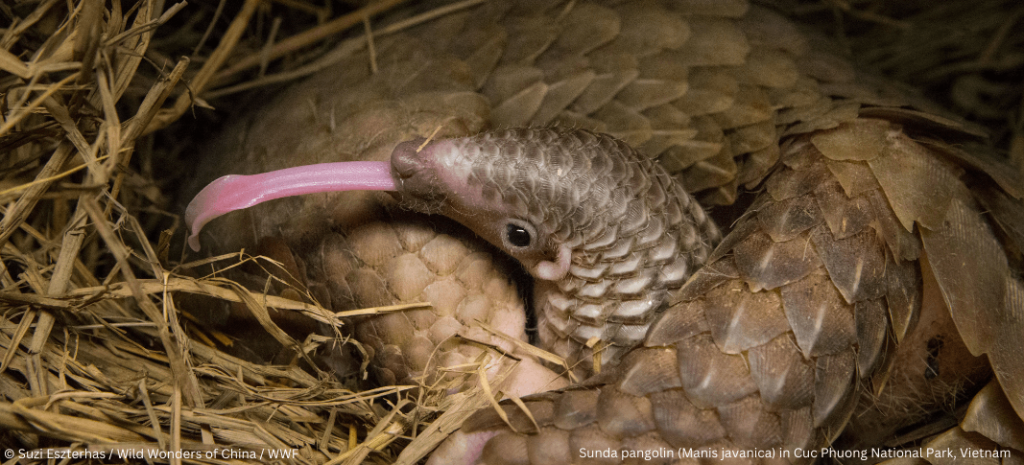
Pangolins are solitary animals that prefer to live and move alone. They reproduce slowly, with females usually giving birth after a gestation period of 70-140 days. The young pangolin stays close to their mother, often riding on her tail for several months. This slow rate of reproduction means that pangolin populations take a long time to recover once numbers decline, making them especially vulnerable to hunting and habitat loss.
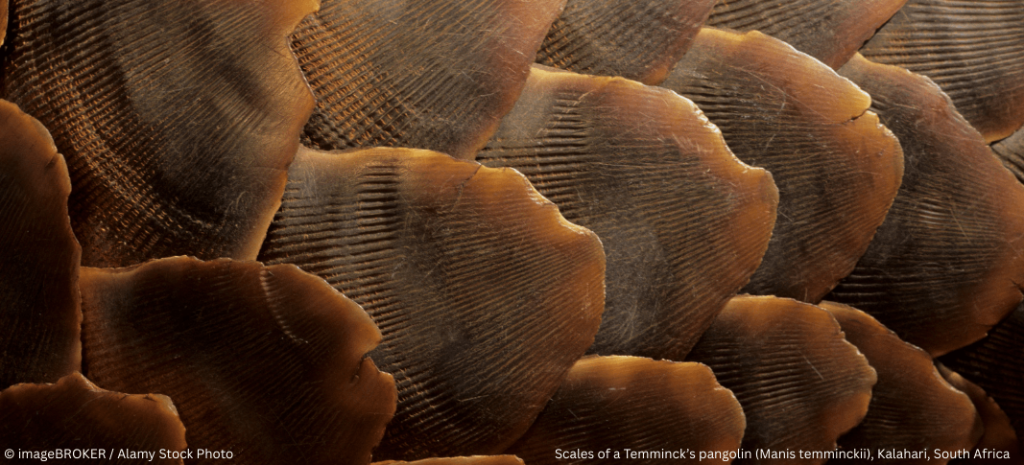
Pangolins have several unusual features that set them apart from other mammals. They are the only mammals in the world covered in scales instead of fur, and these scales continue to grow throughout their lives, wearing down and regenerating naturally.
To protect their sharp digging claws, pangolins walk on the outer edges of their front feet, a movement known as knuckle-walking. Quiet and secretive, they rely more on their sense of smell than sight to find food and avoid danger.
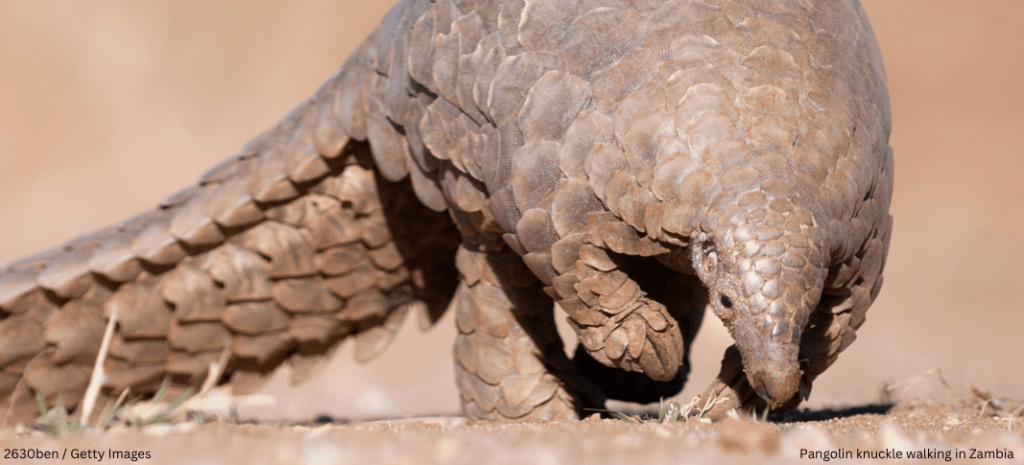
Pangolins have a simple but effective way of protecting themselves in the wild. When they sense danger, they curl up tightly into a ball, tucking their soft face and belly inside and exposing only their hard, overlapping scales. These armour-like scales protect them from natural predators such as big cats or wild dogs. Unfortunately, this defence does not work against humans. When threatened by people, pangolins often remain curled up instead of running away, making them easy to capture.
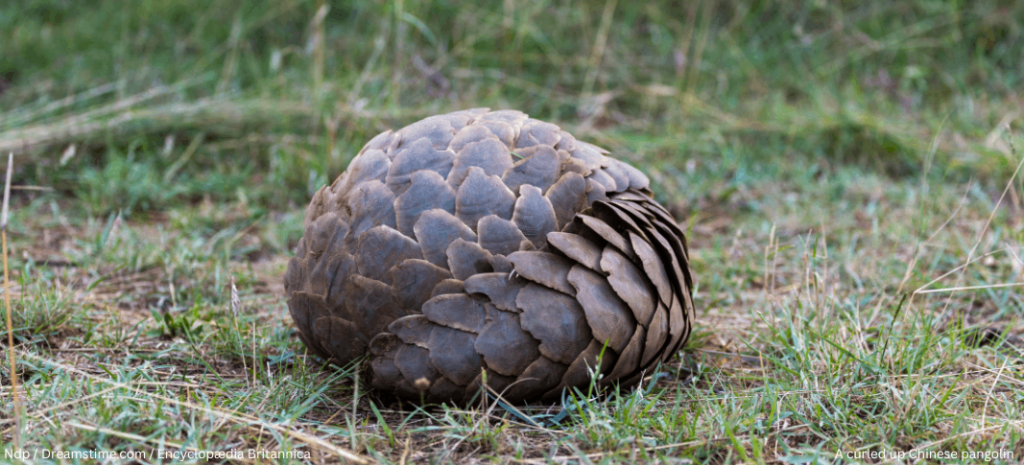
This vulnerability has made pangolins a major target of the illegal wildlife trade. Pangolins are hunted mainly for their scales, which are made of keratin, the same material that makes up human nails and hair. These scales are wrongly believed to have medicinal value. They are also hunted for their meat, which is sold illegally in some markets.
Pangolins are among the most illegally trafficked mammals in the world, driven to the brink by poaching for the wildlife trade. At the same time, habitat loss caused by deforestation, agriculture, and expanding infrastructure continues to reduce the areas they need to survive.
In India, pangolins are protected under Schedule I of the Wildlife Protection Act, 1972, the country’s highest level of legal protection, which makes hunting and trade a punishable offence. Forest departments, researchers, and conservation organisations are working to monitor populations, rescue animals from trafficking networks, and strengthen public awareness.
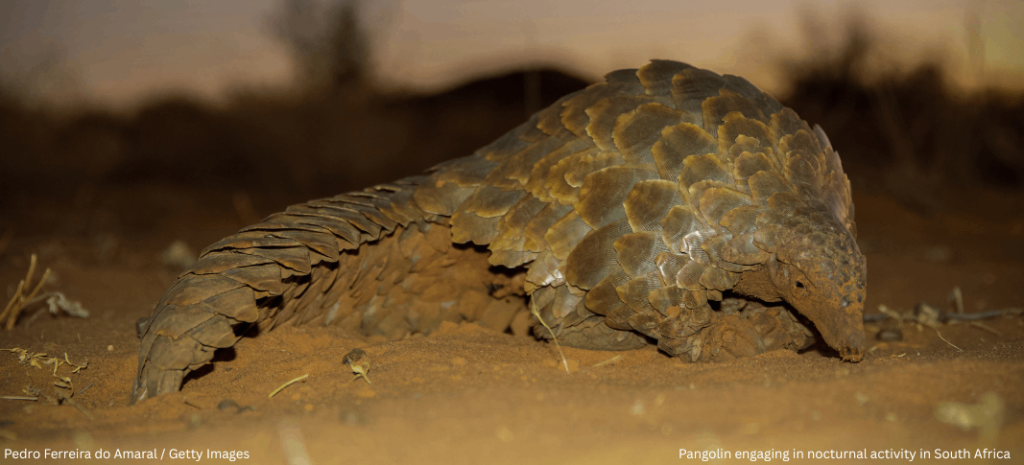
Protecting pangolins, however, is not straightforward. Their shy, nocturnal nature makes them difficult to study and conserve. Long-term survival depends on effective law enforcement, habitat protection, and reducing demand for illegal wildlife products.
Though rarely seen, pangolins play a vital role in maintaining ecological balance. This World Pangolin Day, observed on the third Saturday of February, let us reaffirm our commitment to ensuring these remarkable mammals continue to exist in the wild, not only in photographs.
Activity: Pangolin Myth-Buster
There are many myths surrounding pangolins, and these misunderstandings have contributed to them becoming one of the most illegally trafficked animals in the world. Let’s bust a few of those myths.
What to do:
Read the statements below. For each one, decide whether it is a Myth or a Fact based on what you have read in the article above!
Statements:
- Pangolins are reptiles because their bodies are covered in scales.
- Pangolin scales are made of keratin, the same material as human nails and hair.
- Pangolins have sharp teeth that help them chew ants and termites.
- Pangolins have lots of predators in the wild, therefore they are highly threatened.
- Pangolins are found only in Africa and Asia, with two species living in India.
- Pangolin scales have proven medicinal value.
Answers
- Myth – Pangolins are mammals, not reptiles.
- Fact – Their scales are made of keratin, like human nails and hair.
- Myth – Pangolins have no teeth.
- Myth – Their biggest threat is humans, not wild predators.
- Fact – They are found in Africa and Asia, with two species in India.
- Myth – Their scales have no proven medicinal value.










We’re a group of volunteers and opening a new scheme
in our community. Your web site provided us with valuable info
to work on. You’ve done an impressive job and our entire community will be thankful to you.
«Билайн» в Ульяновске предоставляют:
• пакет из 150+ ТВ каналов;
• бесплатный монтаж оборудования;
• Подбор оптимального тарифа под ваши задачи;
• Анализ возможности подключения по вашему адресу.
[url=https://ulyanovsk-beeline.ru/]проверка домашнего интернета билайн[/url]
интернет билайн тарифы для компьютера – [url=https://www.ulyanovsk-beeline.ru/]https://www.ulyanovsk-beeline.ru[/url]
[url=https://images.google.la/url?sa=t&url=https://ulyanovsk-beeline.ru/]https://www.google.lv/url?sa=t&url=https://ulyanovsk-beeline.ru/[/url]
[url=http://www2.saganet.ne.jp/cgi-bin/hatto/board/wwwboard.pl/www.pelsh.forum24.ru/dtcc.edu.vn/www.1xbet-10.com/www.frei-diplom13.ru]Домашний интернет и цифровое ТВ от «Билайн» в Ульяновске[/url] 49cb901
Way cool! Some extremely valid points! I appreciate you writing this write-up
and also the rest of the site is extremely good.
«Билайн» в Брянске предлагают:
• пакет из 150+ ТВ каналов;
• поддержки 24/7;
• Определение оптимального тарифа под ваши задачи;
• Анализ инфраструктуры по вашему адресу.
[url=https://bryansk-beeline.ru/]билайн тарифы на интернет и телевидение брянск[/url]
билайн домашний интернет и тв тарифы – [url=http://bryansk-beeline.ru]http://www.bryansk-beeline.ru/[/url]
[url=https://clients1.google.ms/url?sa=t&url=https://bryansk-beeline.ru/]https://www.google.com.sl/url?q=https://bryansk-beeline.ru/[/url]
[url=http://www.freifliegendehexe.de/viewtopic.php?f=18&t=1088&p=208635#p208635]Интернет и цифровое ТВ от «Билайн» в Брянске[/url] 791de49
Ищете надежный [url=https://avtomaticheskienozhi.ru]ножи складные автоматические выкидные[/url] — у нас широкий выбор моделей для охоты, туризма и повседневного ношения.
Надежность конструкции во многом зависит от качества материалов и точности сборки.
Experience an unforgettable night as [url=https://drones-show-0.com/]drone light show companies[/url] transforms the sky into a dazzling ballet of light and motion.
The technical coordination behind a drone show involves precise timing and reliable communication.
Improvements in LEDs and battery technology have broadened artistic options.
Regulations differ across countries and typically set altitude ceilings, restricted zones, and pilot certification requirements.
Event organizers often schedule shows to avoid sensitive wildlife periods and migratory paths.
Если вы или ваши близкие оказались в запое, не знаете, как вырваться из этого круга, обращайтесь за помощью на площадке [url=https://vivodizzapoya.asia]вывод из запоя наурызбайский район[/url].
Силы, позволяющие вернуться к нормальной жизни – это результат долгих трудов и упорствующих усилий.
Чтобы понять, как обратиться за помощью, нужно признать, что проблема существует. Пить при этом не перестаешь, но чувствуешь себя подавленно и обессилен. Иной раз человек, выпив, не перестаёт идти далее по жизни, но он чувствует себя подавленно и обессилен.
Алкогольные запои начинаются с легкого удовольствия от выпивки. Но со временем насилие над собой становится невозможно. Человек получает возможность избавиться от вреда от алкоголизма.
Навыки самодисциплины при этом необходимы, но при этом человек часто чувствует необходимость отказа. Тогда человек начинает поисков нового блага. Человек чувствует необходимость отказа от алкоголя, и в итоге он отказывается.
Существует множество методов лечения для алкогольной зависимости. Но все они требуют усилий и времени. Если нужно излечиться от алкогольной зависимости, то существует множество различных методов лечения, которые могут ему помочь.
Одним из наиболее эффективных методов лечения является групповая терапия. Групповая терапия помогает человеку понять, что он не одинок. Используя групповую терапию, человек поймет, что у него есть сила, и начнет свою жизнь с новыми задачами.
Поддержка семьи и друзей – это ключ к выздоровлению. Человек, получающий поддержку, более легко справляется с зависимостью от алкоголя. Включая семью и друзей в процесс выздоровления, человек становится более легко устойчивым и устойчивым в борьбе с алкогольной зависимостью.
Поддержка также может быть получена от специальных центров реабилитации. Программы реабилитации помогают человеку понять причину зависимости и найти пути к выздоровлению. Поддержка центра реабилитации позволяет человеку понять причину алкоголизма и найти пути к выздоровлению, таким образом он может получить реальную поддержку в стремлении к здоровью.
Merhaba! Son zamanlarda [url=https://betkomgiris.casino]betkom[/url] takip ediyorum ve harika. Siteye erisim icin [url=https://betkomgiris.casino]betkom guncel giris[/url] buraya bakabilirsiniz. Iyi sanslar!
Savjet dana bez komplikacija — https://www.heliosgravina.it/2026/03/01/sto-je-najbolje-jesti-navecer-navedeno-je-13-namirnica-za-dobar-san-2/
.